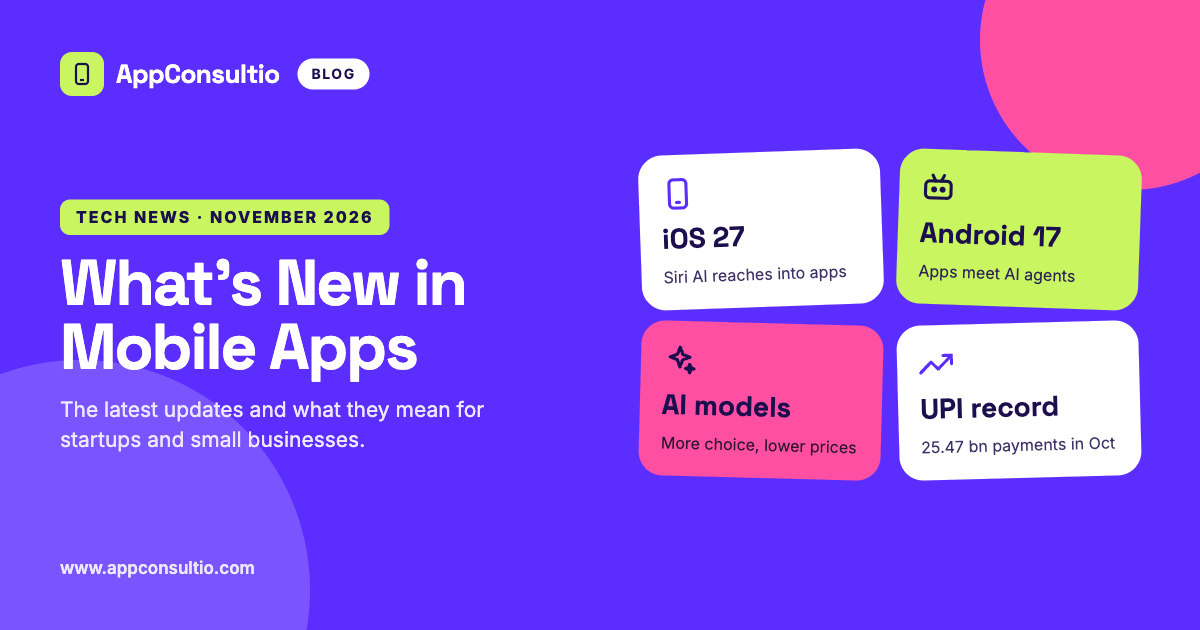
Phones are turning into AI assistants, and apps are becoming the tools those assistants use. In the last few months, Apple shipped iOS 27 with a rebuilt Siri, Google pushed Android 17 towards AI agents, new AI models arrived almost weekly, and UPI set another record in India.
Here is a quick roundup of the updates that matter most if you run a startup or small business, and what each one means for your app.
Apple: iOS 27 brings Siri AI into apps
Apple released iOS 27 in September 2026 as a free update. The headline is a context-aware Siri rebuilt for generative AI, alongside the next generation of Apple Intelligence. Apple also says apps launch up to 30% faster than on iOS 26 (91mobiles).
For developers, the iOS 27 SDK adds App Schemas and new App Intents features, so Siri and Apple Intelligence can reach inside third-party apps. The Foundation Models framework still gives every app free access to the on-device AI model.
What it means for you: customers will soon expect to say “book my usual appointment” or “reorder my last purchase” to Siri. Apps that expose these actions now will be easier to use, and easier to find, than those that don’t.
Google: Android 17 opens apps to AI agents
Android 17 rolled out to Pixel phones in June 2026, and more devices are following. Google is still updating it, with a fourth beta of the next quarterly release arriving on 12 November 2026 (Android Developers). Three changes stand out for business apps:
- AppFunctions: apps can offer their features as “tools” that AI assistants such as Gemini can find and run for the user.
- Adaptive-first apps: apps targeting the new API level 37 must work at any window size on tablets, foldables and laptops. Google counts over 580 million large-screen Android devices in use.
- Tighter security: for most apps, access to SMS one-time passwords (OTPs) is delayed by three hours, and local network access now needs a new permission.
What it means for you: if your app reads OTPs from SMS for login or payments, check that it uses Google’s approved verification methods. Plan for tablet layouts and AI-assistant actions in your next update.
AI models: more choice, lower prices
November 2026 has been one of the busiest months yet for AI. More than 20 new models had launched by 18 November, from labs including Anthropic, OpenAI, Google, Meta, Alibaba and Tencent (Capital & Compute). The bigger story is price. Top models such as Claude Fable 5.2 and GPT-6.2 Astra launched about 20% cheaper than the versions they replace. Small models such as Meta’s Muse Ember and Tencent’s Hy4 flash launched at under $1 per million tokens of output (roughly 750,000 words).
What it means for you: features that were too expensive a year ago are now affordable for small apps. Chat support, smart search, voice notes, document reading and personalised recommendations are all in reach. The trick is to pick the right model for each job, often a small, cheap one, and switch easily as prices fall.
India: UPI hits a new record
UPI processed a record 25.47 billion transactions worth ₹31.53 lakh crore in October 2026, according to NPCI data (Entrepreneur India). Average daily value crossed ₹1 lakh crore for the first time, and volumes grew 23% from a year earlier (Free Press Journal). NPCI also put off its planned merchant discount rate (MDR) on some UPI payments until after Diwali, so merchant fees remain one to watch.
Data privacy is the other big shift. India’s Digital Personal Data Protection (DPDP) Rules came into force in November 2025, with an 18-month phased timeline for businesses to comply.
What it means for you: a smooth UPI checkout is now a must for any app that takes payments. Build clear consent screens and secure data handling in from the start, before the DPDP deadlines arrive.
What this means for startups and small businesses
You don’t need to chase every update. Five practical moves will keep your app current:
- Make your app “assistant-ready.” Expose key actions (book, order, track, pay) so Siri and Gemini can trigger them.
- Add one useful AI feature. Start with something simple, like smart search or chat support, using an affordable model.
- Check your login and OTP flow. Make sure it still works smoothly under Android 17’s new SMS rules.
- Design for every screen. Phones, foldables and tablets should all get a clean layout.
- Build payments and privacy in early. Use smooth UPI checkout, clear consent screens and secure data handling.
Starting a new app? An MVP lets you launch the core idea first and add these upgrades as your users grow.
Build your next app with AppConsultio
At AppConsultio, we keep up with these changes so you don’t have to. We build custom Android and iOS apps for startups and small businesses, at a budget that makes sense. We add AI, UPI payments and privacy features where they bring real value.
Have an idea you want to test? Start with a custom MVP from just ₹60,000/-*.
Book your free consultation:
- Phone: +91 7385024414
- Website: www.appconsultio.com
- Email: info@appconsultio.com
*Terms & conditions apply. Final pricing depends on features and scope.